PART TWO - AGGRESSIVENESS
Agonistic Behaviours:
Definition: Threatening and attack behaviours, both offensive and defensive. These behaviours are used in conflicts, or in response to a threat, an attack or a disturbance. They can be used to create / maintain distance from their opponent across space and time (Gattermann, 1993).
Aggressiveness
Definition: an internal or motivational state which influences an animal's predisposition to behave aggressively.
Aggressive behaviour
Aggressive behaviour is part of the social behaviour of dogs, and represents a part of their normal set of behaviours. (Bradshaw e Nott, 1995). All dogs can display aggressive behaviours, although their propensity to do so varies. While aggressive behaviour has an important function in canine communication, and may be appropriate in context, both degree of tolerance of it and the real danger it poses vary considerably, and it may be considered unacceptable.
Various authors have indicated the factors that influence aggressive behaviour:
PREDISPOSITION
- characteristics deriving from breed selection
- personality
- age
- sex
- early experiences (socialisation)
- previous experience
- social status
CONTINGENT FACTORS
- all those elements which provoke the exhibition of a certain behaviour in a given context.
In puppies (Schoening, 2000; Scott e Fuller, 1965), biting behaviour appears between the third and fourth weeks of age. These bites are not inhibited (Fox, 1971), and are directed towards littermates; these interactions end with either the puppy on the receiving end responding with a bite, or moving away to escape the situation (Schoening, 2006). Only from the end of the fourth week onwards do interactions which up to then were characterised by a simple uninhibited bite change, in terms of type and quantity, taking on the form of true agonistic interactions, with all of the elements of communication and the variations which go with them (Schoening, 2006).
“He's not aggressive: he's never bitten anyone”
The last time it happened was just a week ago.
I was describing the interactions taking place in a group of dogs, and defined two of the dogs in the group as 'aggressive'.
The owner of one of the two dogs stiffened; she was clearly annoyed, if not outraged. When I had asked her earlier to describe her dog, she had defined him as “very sociable, with great social skills, not aggressive, able to get along with all dogs”. I had no doubts as to why she didn't share my evaluation of her dog's behaviour.
While it's clear that I can of course be wrong -- an evaluation for me involves formulating a hypothesis and I'm always ready to integrate new information into my initial observations -- in this case, my evaluation stemmed from having observed the dog cut across the path of another male, effectively blocking him and keeping him at a distance from a young female Golden Retriever.
This behaviour (cutting across the path of another dog, placing himself between other dogs, belongs in both the category of imposing behaviours and that of agonistic ones. In the case of this dog, the increase in intensity, associated with growl-barking, blocking his rival and staring him in the eyes with a hard eye gave me extra information. However, the dog didn't bare his teeth, growl or attack, and above all, didn't bite.
And yet, aggressiveness doesn't regard biting alone. Aggressiveness can be displayed with a wide and rich range of behaviours, some of which are incredibly subtle (a momentary glance, or nearly indiscernible stiffening ...). If we want to learn to recognise and understand aggressiveness, it's important not to limit our observations to behaviours that are in reality only the tip of the iceberg, and we need to accept the idea that even dogs who don't bite, who have never bitten and probably never will can nevertheless be aggressive.
Indeed, the normal tendency to equate aggressiveness with biting has two consequences:
- the recognition of only those behaviours which are directly associated with biting as aggressive behaviours (”Is he aggressive ? “No! He's never bitten anyone !”)
- the fear people have that if they recognise aggressive behaviours, their dog will be labelled a “dangerous dog”, and the consequences this may have (beyond the owner's sense of having failed in the relationship, who may feel responsible for not having raised their dog properly or not having trained, socialised or controlled it adequately).
A dog may exhibit threatening behaviours throughout his entire life, without ever biting anyone.
Being aware of these behaviours is instead an absolutely essential part of recognising a dog's emotional state, his ability to cope with a situation, and thus our ability to give him the possibility to avoid stressful situations and to develop alternative strategies.
In some cases, recognising subtle signals of aggressiveness can be of fundamental importance in avoiding the development of problems with behaviour, with managing and handling dogs and in our relationships with dogs. The reality is that dogs that bite are often dogs who have never been listened to and were not listened to before the biting episode. It must be terribly frustrating for a dog who declares his intention but doesn't receive an adequate response from people.
As regards the fear of having a "dangerous dog", several years ago I set up a working group which is based on a shared non-judgemental philosophy and in which dogs are viewed without prejudice. Owners who arrive with a dog that exhibits aggressive behaviour sare not isolated in any way, and they most certainly are not criticised or 'accused' of anything; often they find themselves feeling, for the first time, accepted and 'normal'. Any and all progress, however small, is greeted with enthusiasm by the entire group, a positive and constructive attitude that has extremely beneficial effects on the owner... and on the dog ! The first step towards this result is the development of a strong sense of empathy toward the dog and its owner, which involves the entire group in the rehabilitation process.
Measuring aggressiveness
When a dog exhibits aggressive behaviour, be it in a behavioural evaluation or in an interaction with another dog, we can use a scale to measure the intensity of the aggression.
The score is assigned to the dog on the basis of the most intense behaviour displayed, using a scale that can be based on this simple principle:
0 = the dog did not exhibit aggressiveness
1 = the dog exhibited aggressiveness, but did not bite
2 = the dog exhibited an inhibited bite
3 = the dog exhibited an uninhibited bite
When I began to analyse video footage of aggressive interactions between dogs, I realised that, although they give us important, bites alone don't tell us everything we need to know about aggressiveness. That's why, rather than limiting myself to assigning a score based on biting, I took note of and measured all aggressive behaviours, analysing the frequency of 110 different behaviours exhibited in 150 dogs interacting freely with other dogs.
This research (conducted in collaboration with Prof. Paola valsecchi of the University of Parma, Italy) is still underway, although preliminary results were presented at the 2010 Canine Science Forum in Vienna.
NOTE: The full spectrum of aggressive behaviours is much wider than just the behaviours associated with biting. In order to observe dog behaviour -- to evaluate, understand, and prevent it (and to help the dog)-- it's necessary to be able to recognise all of the agonistic behaviours.
Making a statement
As I was preparing my talk on aggressiveness for the 2010 Canine Science Forum in Vienna, one of my concerns was which video clips to use. I chose a clip of a lateral attack, in which a male Australian Shepherd attacks a male Belgian Groenandel Shepherd.
When I chose the video to use for the ethological analysis, I included all the interactions between the two dogs that preceded the aggression. The two dogs meet, there's a certain tension between them, they each mark at the fence (they are offleash in a fenced training field; their owners and several other dogs are also present ). The dogs move away from each other, cross paths a second time, and for the second time the male Australian Shepherd exhibits behaviours that I define as “making a statement”: in other words, the dog exhibits behaviours that indicate an intention, that affirm his perceived role in the relationship, and the strategy he will adopt in case of a conflict.
A statement can be made with a glance, movement, or posture.
The third time the dogs cross paths we see first a warning, then an aggression. A superficial observation might lead one to believe that the aggression occurred all at once without warning, but a careful reading of the most subtle warning signals makes it possible to trace back the cause of the aggression to the earlier interactions. This is a face-off between two opponents, and the aggression is a strategy used by the Australian Shepherd to define his relationship with his rival.
The dog uses subtle signals involving threatening and aggressiveness to COMMUNICATE, and not just to intimidate his rival, defend himself, win in a conflict or get the better of his rival.
Even during aggressions, when dogs have their mouth wide open and are showing all their teeth and seem to bite, their aggressiveness in any case maintains an important role as a form of communication. The situations in which dogs use aggressiveness to communicate, to express their emotional state, to defend themselves or to make a statement are vastly superior to the situations in which the objective is to cause damage.
The dogs which attack other dogs with the goal of doing harm are mostly dogs that have been subjected to an extremely high level of stress, dogs which have lost the ability to control their emotional reactions and communicate with other dogs. And these dogs are often desperate.
NOTE: Aggressiveness is not just an offensive act or a self-defense strategy: it also plays an important role in communication.
Dogs can communicate through aggressive behaviours.
In order to make the intention to communicate clear, the dog needs to be able to modulate his own behaviour, to change it in response to the signals he receives from his rival, and to exhibit a reaction that is contextualised (that is, the dog exhibits aggressiveness in an appropriate context) and to exhibit an inhibited bite.
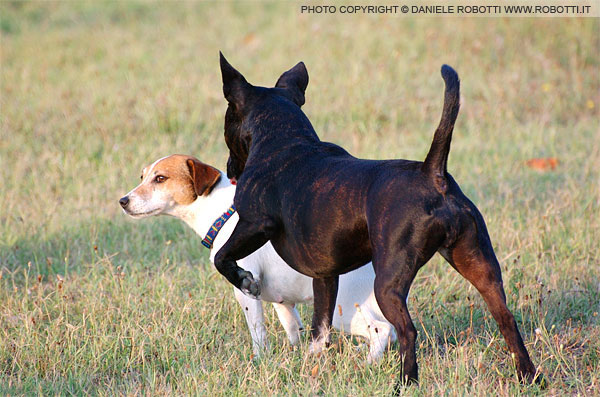
Brick is a bitch with considerable social skills and who is not very aggressive. Her weak point is interactions with Jack Russel Terriers: on the rare occasions in which she encounters a dog smaller than herself with a very strong character, she will face off with it. The statement she makes is clear: "I am the stronger of the two of us." The behaviours she exhibits are T position, standing tall, an offensive facial expression, and arched tail. The raised paw not only shows her intention to move forward and displace her adversary, but is also a sign of insecurity caused by the unexpected passive resistance of this female Jack Russel. Scheggia sits, shoots a glance at Brick without staring at her, but doesn't budge.
Aggressiveness: genes and the environment
When talking about aggressiveness, one of the problems is being able to distinguish the individual characteristics from behaviour in a specific context. One study (Svartberg & Forkman, 2002) conducted on more than 15,000 dogs highlighted several characteristics of the personality of dogs, one of which was aggressiveness. The results of this study would seem to indicate that there are individuals who are more aggressive and others who are less aggressive.
A dog who exhibits aggressiveness is aggressive, but is he more aggressive than other dogs? Is aggressiveness an individual tendency present from birth ?
We can think of the aggressiveness of an individual as his tendency to resort to an aggressive strategy in a dangerous situation or conflict: a more aggressive dog will be more likely to exhibit aggressiveness in these situations than another less aggressive dog. We can also think about it in terms of threshold of reaction: a more aggressive dog reacts with aggressiveness to stimuli at a lower level of intensity, or with shorter latency, with respect to a less aggressive dog.
The most aggressive of all my dogs is probably my German Shepherd bitch, Ginger. And yet, most people who have met Ginger certainly wouldn't define her as aggressive: she is a very sociable dog, who is also very stable emotionally. These characteristics make it unlikely for Ginger to perceive a situation as dangerous or conflictual, and thus it's unlikely for her to choose a strategy involving aggressiveness, as her reaction threshold is very high. While I believe Ginger is a bitch with a medium/high level of aggressiveness, only very rarely do I see her exhibit clearly threatening behaviours, and she has never attacked or tried to bite dogs or people.
Besides other personality traits that can mediate the dog's level of aggressiveness, it's necessary to take into account Ginger's relationship with me (she trusts me, and relies on me), and my handling of her. It's possible that in the hands of another owner, and in different situations, Ginger's aggressiveness might come out with a different frequency, and with different intensity.
Context is a key factor in the evaluation of aggressive behaviour. All dogs can show aggressivenes, regardless of their personality.
There is a strong link between anxiety, stress and aggressiveness, and the information that a dog receives from other individuals (dogs and people) is undoubtedly important.
Before labelling a dog as "aggressive", it's important to reduce the levels of stress the dog is subjected to, and to bring the dog's social relationships back into balance, so that other possible strategies can emerge for the dog to use in dealing with situations of perceived danger or conflict.
When describing interactions between dogs, or their reactions during an evaluation, I am constantly reminded of how difficult it is for the observer of aggressive behaviour to distinguish between and separate the various elements. A dog may show aggressiveness and yet, in my evaluation, be considered "not aggressive" or may not show bite-related aggressive behaviours, but in my eyes still be defined as "aggressive". While these evaluations are derived from scientific studies, they are based on a framework that involves personal interpretation, and as such have a component of subjectivity. The difference between the two cases described however lies in the different influence of the environment (including states of anxiety, stress, fear, experiences associated with different stimuli, social relationships), and of the dog's personality (the traits that determine individual differences present from birth).
NOTE: “Aggressive” can indicate the display of threatening or attack behaviours in a specific context, or a personality trait.
While it's always possible to observe and describe the aggressive behaviours in a given context, before defining aggressiveness at the level of personality, it's necessary to conduct evaluations in different contexts, and an evaluation of all the variables that can influence a dog's behaviour.
Aggressiveness: categories
Various authors have identified the following categories of aggressive behaviour:
- Fear-induced aggressiveness
- Dominance-related aggressiveness
- Territorial aggressiveness />
- Aggressiveness in play behaviours
- Aggressiveness in defending resources
- Redirected aggressiveness
- Aggressiveness related to pain
- Food-related aggressiveness
- Maternal aggressiveness
- Idiopathic aggressiveness
- Aggressiveness between individuals of the same sex (male/male or female/female)
- Aggressiveness indiced by punishment
(Borchelt e Voith 1986, Overall 1997, Beaver 1999, Shoening 2000)
Aggressiveness: defensive and offensive
Aggressiveness has been defined and divided into different categories by various authors. In my current study of intraspecific (dog-dog) aggressiveness, I have identified two distinct categories, on the basis of the behaviour of the aggressor in the phase preceding the aggression:
- defensive aggressors: the dog shows behaviours used to create distance between itself and other dogs (an increase in the social distance), fear and de-escalation in the phase preceding the aggression.
- offensive aggressors: the dog shows approach behaviours (reduction of social distances), and / or imposing behaviours in the phase preceding the aggression.
This distinction is not based on an interpretation of emotional states (fear, anger), nor is it based on the dogs' behaviour during the aggression phase itself, but rather on behaviours observed before the aggressive interaction. Beyond the advantage of reducing subjective interpretations, this distinction has revealed statistically significant differences among the four categories (aggressors, victims) analysed in the in the phase preceding the aggression and during the aggression.
One result which has already emerged and which is entirely new has struck me as particularly interesting: that is, the tendency of the victims to react with a level of aggressiveness equal to or inferior to that of the aggressor. This is in total contrast with what is taught in certain dog training circles (that is, ”if a dog threatens you, show him you're not someone to mess with, demonstrate that you are stronger than he is”).
Another element that has emerged in our study is that aggression by offensive aggressors is in most cases not a response to a provocation by the victim. The victim may have exhibited confrontational, threatening or provocative behaviour in the past, but this behaviour is not the immediate cause of the aggression during the single episode.
NOTE: In all of the aggressive interactions that I have analysed, the victim reacted with a level of aggressiveness equal to or often lower than that of his aggressor, even when the dog was physically at an advantage, or had taken on the role of aggressor in other interactions. The difference can be caused by the different motivational state of the aggressor and the victim, or be a strategy that limits the risk of an escalation. In cases in which the victim was at an advantage (either in terms of physical strength strength of character) not increasing the aggressiveness to a higher level may indicate that strategies other than "an eye for an eye" are more efficient during a face-off.
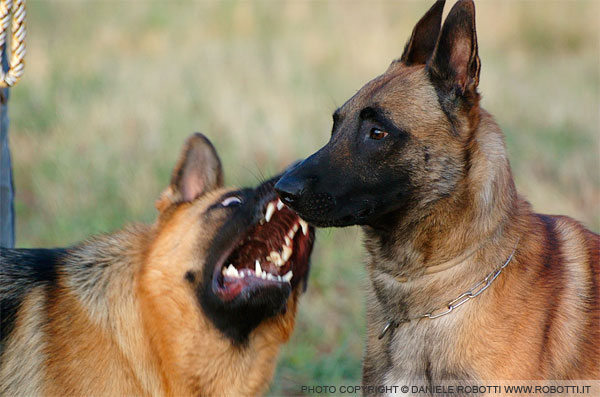
In defensive aggressions, the protagonists are often a male displaying courtship behaviours, or an approach from the rear, and an 'unruly' female who resorts to a threat display if other strategies to block the male haven't worked. This female German Shepherd is rejecting the approach of the male Malinois. The female barks and exhibits an open mouth display; the male moves away, ears turned to the side and held high. He avoids eye contact, and a certain degree of tension is clear.
Aggressiveness: dominance and resources
An episode during a seminar by Sue Sternberg changed my perception of possession and aggressiveness associated with conflict over resources. A pit bull grabbed a cloth tug rope, then let it fall, then walked around the seminar room entering into contact with various people. Sue's comment was: “Did you see that ? He has just exhibited resource-related aggressiveness ”. Everyone nodded. I raised my hand and asked in what way he had shown aggressiveness, given that he had dropped the tug toy and had seemed more or less friendly ... Sue explained that this behaviour is typical of dogs who are very possessive (and aggressive): leaving the resource on the ground and nearing a possible adversary, thus making a statement about the possession of the object.
I witnessed a similar scene just two days later: a young Eurasier left a ball on the ground, and walked toward my Border Collie, Bran. Bran pinned his ears back, froze, lowered his body posture and looked at me. For Bran, the meaning of the Eurasier's approach was only too clear.
In an article in which she described the behaviour of dogs who had been diagnosed as showing 'dominance aggression', Karen Overall wrote: “Clients don't understand why their the dog often attempts to get their attention and then bites when they give him their attention”. In some cases, this behaviour could be compatible with that described above.
For many years now I have been observing possessive behaviours, and the aggressiveness which can spring from conflict over a resource. Although today the behaviours that dogs exhibit in this context are clear to me, I'm still in the research phase as regards the causes. What is certain is that many dogs "anchor" themselves to resources in situations involving considerable social stress, but there are also dogs that show a tendency to control resources that is tied to their personality, and in some situaztions dogs can use resources to define the terms of a relationship. In the latter case, the presence of a resource would not be the cause that determines the aggressive behaviour; the dog is aggressive not because it is defending a resource, but because the context causes latent conflicts in the relationship to emerge.
Also in this case, the behaviour of the dog can be much more subtle than an open threat display. During the evaluations carried out in the ambit of our research project on dogs that had bitten, I evaluated some dogs that demonstrated absolutely no interest towards a bowl of food. Despite the fact that the dogs were not eating, looking at the bowl or the floor, and at times were not even near the bowl, we tried to follow the entire test procedure. An aggressive dog will react as if he were guarding a resource.
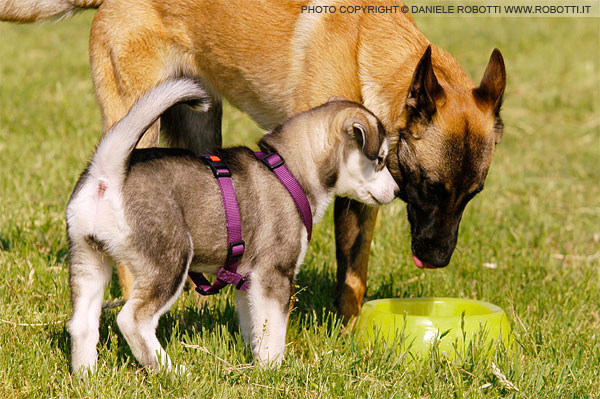
Aggressive behaviours can also be exhibited by puppies. In this photo, little Tika guards the bowl of water from the young Malinois Nobel. The behaviours exhibited by Tika are an expensive facial display, staring and arched tail. Nobel's ears are pinned back; he is licking his nose and averting her gaze.
Behaviour and emotions
Unless one has a magic crystal ball, the analysis and evaluation of a dog's behaviour need to be based on two elements: its personality and the behaviours exhibited by the dog in a certain moment.
An understanding of the dog's personality allows us to make forecasts about the strategies that a given individual will adopt in a specific context, while the observation of a dog's behaviour helps us to understand his emotional state, his intentions and reactions.
In animals, emotions provoke changes at both the physiological and behavioural/expressive levels. Different emotions can give origin to different behaviours and facial expressions. The term emotions in fact refers to the physiological and behavioural changes which occur in response to particular circumstances and are strictly observable and measurable (heart rate, posture).
Grisou, my Border Collie, has difficulty controlling his emotional state when he is with other dogs. He is now able to control himself in the presence of dogs that are not threatening him. Before this happens, I'm able to foresee that he will react aggressively if a dog stares at or threatens him. If we are out for a walk and I see Grisou lift his tail until it is bent backwards arched up over his back, stiffening, raising his head and displaying a hard eye, I know that he is experiencing aggressiveness, even if I haven't seen another dog threaten him.
Taken together, the information we have regarding a dog's personality and the information derived from direct observation of its behaviour make it possible for us to define the emotional state of a dog in a given situation.
At the same time, recognising the emotional state of the dog allows us to foresee his intentions and reactions.
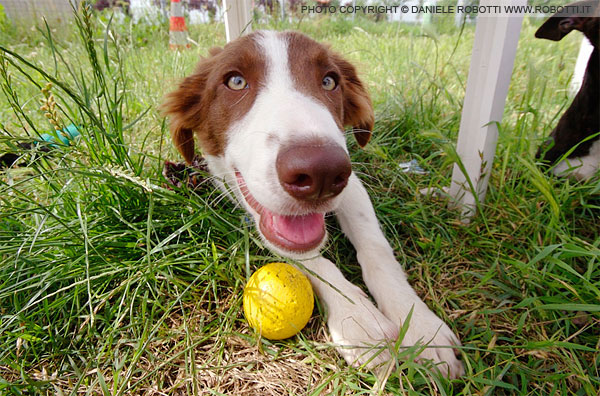
Grisou disguised as an innocent puppy...
PART ONE Introduction
PART TWO Aggressiveness
PART THREE Ethogram of Agonistic Behaviours
start - contents - authors - bibliography - books & DVD |
