PART TWO - Imposing behaviours
Definition: Imposing behaviours are relatively fixed and ritualised. They do not involve confrontations with intense, prolonged body contact; each dog demonstrates what it feels to be its strength and status. (Zimen, 1971; Umlauf, 1993; Schoening, 2006)
Dominance: myth and fashion
Definition: Dominance is the product of repeated agonistic interactions betwen two individuals, in which both components of the dyad recognise the other's position and modify their reciprocal responses, passing from symmetrical to asymmetrical behaviours.
A dominance relationship develops between two animals when this assymetry is the result of repeated agonistic interactions and can be measured, as one of the animals (the dominant one) consistently wins out over the other (the subordinate one) in interactions involving resources.
(Immelmann et al., 1996)
In the last ten years, dog training, both in Italy and throughout the world, has been shaken up by an extraordinary amount of new scientific knowledge and information; in a sense, by new fashions, and new myths.
In the past, in describing the world of dogs, virtually every aspect of social relationships was defined in terms of dominance hierarchies; today, there are also those who reject any explanation whatsoever if it is based on a hierarchical structure. We have shifted from a vision of a world populated by pack leaders and their “subordinates”, individuals in constant and often vicious competition for the alpha role, to that of a world of peaceful collaboration and respectful friendship, a world without conflicts in which an individual is accorded the role of recognised guide or leader.
However, both points of view err in their excessive simplification, and are so extreme that they limit the analysis of a reality which is instead much more complex and changeable.
It is not my intention to discuss the different interpretations and motivations of these two schools of thought, but rather to describe the behaviours included in the category of imposing behaviours. On the other hand, the discussion of these behaviours requires that both a certain degree of competition and differences in social status be taken for granted.
Imposing Behaviours
Dogs use their posture and behaviours to make a statement regarding their self-perceived power and status, but only by analysing the context and the real consequences of these behaviours is it possible to define whether or not they have been effective.
A dog may stand tall in an encounter with a puppy or smaller conspecifics; it may also adopt an imposing stance when there is no real confrontation, not because it feels powerful, but rather because it feels insecure. A dog may try to influence the use of space by another dog without suceeding, and a dog that sniffs and marks over the urine of other males when they are absent may be not nearly as self-assured when he encounters them face to face.
Moreover, exclusive possession of a resource often discourages competition: if a dog has a toy or bone, a more confident dog may decide NOT to take it. In this case, though, it is important to distinguish the motivation of competition from the outcome of the interaction: just because a dog doesn't want to enter into competition with another dog doesn't mean he would not be able to win.
Take, for example, this scenario: during play, a dog succeeds in grabbing a ball before another dog is able to reach it. In the moment in which the dog grabs the ball, he needs to be able to evaluate a set of information about the companion he is playing with. If the other dog makes it clear that he wants to take the toy, the first option is simply to ignore him. The dog with the ball can move away. He can move away. He can exhibit the ball as if it were a trophy, or use it to declare his right to keep it. If the other dog perceives himself as having more power to decide the outcome of the interaction, then a glance, a step forward, or stiffening a bit may be enough to convince the dog who grabbed the ball first to spit it out. From that moment on, he might not even try to get it back again, regardless of his motivation to play. If roles are well-defined, the imposing behaviours used will be extremely subtle.
One night our Malamute killed a coypu -- a large rodent. The next morning, not much was left of the poor animal, except for its head and a piece of its trunk. Akiak paraded around our garden with her trophy held proudly in her mouth, and no one, my husband included, was able to convince her to surrender it. As I walked out the door of the house I took one look at Akiak and headed immediately back inside to look for something tasty to offer her in exchange for it. When I showed the food to Akiak, she responded by moving quickly away with the remains of the coypu held tightly between her teeth. I put the food in my pocket, and began to walk over to her, determined to have my way. As I took a step towards her I said in a normal, nonchalant tone of voice “spit it out”. Akiak spit out the coypu's head, and let me pick it up.
NOTE: In exhibiting imposing behaviours, it is not so much the action which is important, but the dog's temperament. Indeed, imposing behaviours are in essence a declaration of who one is, and of one's perceived role in an interaction. As a result, dogs who have developped social expertise tend not to use imposing behaviours towards stronger individuals, and may also decide to abandon the idea of imposing their will on individuals who are weaker or under emotional stress.
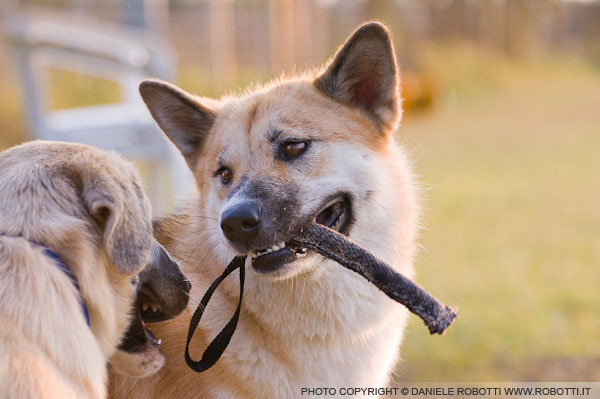
Here, the Alaskan Malamute cross challenges the Spanish Mastiff puppy to grab the toy. Competition is part of play, and is also useful in collecting information about the temperament and self-perceived power of one's companions.
Social control
People control their dogs by using physical equipment, such as collars and leashes, fences, gates and doors. They control dogs through the use of physical strength, counting on the advantage of our larger size. And sometimes they control dogs by inspiring fear, or causing pain. There is, however, a form of control that is more natural and more easily understandable for dogs: social control. Social control is based on relationships and on communication, and implies the ability to influence a dog's behaviour through the use of imposing behaviours.
People spontaneously use commands to obtain social control: if we want our dog to leave the kitchen, we order him with sternly to “get out of here!” while staring and moving closer and closer, until we've crowded him enough to displace him. If that doesn't work, we can use a commanding gesture, pointing a finger toward the door and raising and hardening our tone of voice, blocking the dog's path if he tries to skirt around us to avoid leaving the room. Numerous studies have demonstrated our dogs' ability to understand our pointing gestures, and it is likely that dogs learn to associate a louder, stronger tone of voice with unpleasant consequences (aggressive behaviour on our part).
For it to be truly effective, social control needs to be based on self-awareness (a realistic appraisal of who we are in relation to the dog), to be expressed with clear, understandable and consistent behaviour, and to be founded on communication. It's useless to stubbornly apply a few rules in our attempt to control our dogs, such as inisisting on passing through doorways before them, eating before the dogs get fed or ignoring their requests for attention, if these choices don't have their root in our perception of ourselves and an understanding of the context of our interactions (that is, of how the dog perceives a situation). What's more, it's important to give consistent information at all times, not just when we need to exercise control. Communication requires the ability to modulate one's own behaviour, and ensure that a channel of communication with the dog truly exists and is maintained.
NOTE: in recent years, training programmes and protocols have tended to include forms of control based on the control of resources, and the association of desired or useful behaviours with positive reinforcement. In other words, in order to obtain something he likes, the dog exhibits a learned behaviour. This is a form of control which doesn't use coercion, but that is often ineffective, since the dog can choose not to collaborate if the value of the reinforcer isn't high enough to compete with other stimuli, or with stress.
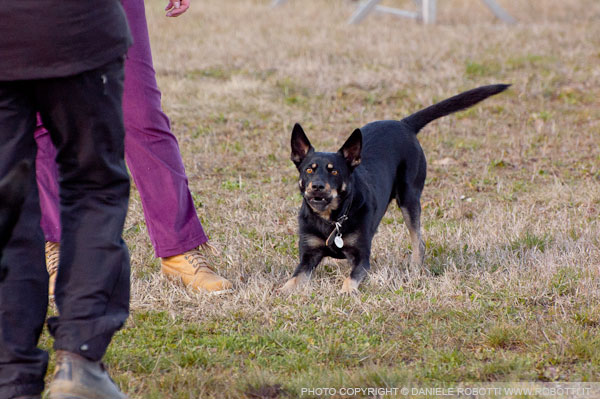
In my fieldwork, I've learned to reproduce dog behaviours, with surprising results. In this case, I exert social control over the mixed-breed dog, who reacts by staring into my eyes, a slight agonistic pucker and a bow to stop me.
Competitive play and games
Let's take another scenario: a 2 month-old female Bull Mastiff puppy is playing with a young Border Collie. The puppy bows, leaps forward, and runs. The Border Collie bows, swerves aside, and runs. After a few minutes, the Bull Mastiff puppy is sitting in the middle of the field, staring at the adolescent Border Collie. The Border Collie is standing still near the fence, far away from her owner and the other people present. The two females haven't exhibited any aggressive behaviour, and yet the fact that the Border Collie is uncomfortable in this situation is crystal clear. Indeed, play may involve elements of confrontation, and can highlight the lack of symmetry in an interaction a 'bloodless' way.
All dogs know this, and thus take play very seriously, above all when their playmate is a dog they've just met. The one who very often does NOT know the rules of the game is the dog's owner.
Observing someone playing with their dog provides a great opportunity to evaluate their relationship and the communication between the two. Although they are often unaware of it, dog owners tend to shift the rules of the game towards confrontation, trying to assert themselves over their dog in an effort to get him to relinquish his hold on a toy. If the dog perceives the owner as having the upper hand, he may choose to leave the interaction, to stop playing, or to surrender the toy. On the contrary, for it to be a real game, the dog and person need to play together as a team. And passing the ball to a fellow team member is part of the rules of the game!
There's control, and then again, there's ... control
Our interpretation of the term 'imposing' implies a relationship between two individuals in which one of the two appears to be at an advantage. The stronger of the two has the right to control resources, and to interfere with the other's behaviour. However, there are two aspects of this control that it's worth stopping to think about.
The first regards the effects of control and of the foreseeableness of events on our dogs' well-being. The consequences of an event in general are evaluated in terms of reinforcement or punishment. A behaviour will increase in intensity and/or frequency if it is reinforced, and will decrease in intensity and/or frequency if associated with a punishment. The ability to foresee the consequences of a behaviour, to obtain something desireable or avoid something unpleasant (control) also has a lot to do with the emotional well-being of dogs, in that it can influence relief, frustration, confidence, and drive to learn. Being able to control and foresee events in their world has a positive effect on dogs. It's also obvious that these controlling behaviours can be positive or negative for the other dogs and people who are subjected to them.
Here's another example. Let's say that every time we feed a certain dog, he jumps up on us excitedly, scratching us with his nails. A trainer explains to us how to improve the situation: by teaching the dog that the only efficient strategy to obtain the food is to sit. Within a few days, the dog has learned that by sitting he can obtain food. Some dogs will then go a step further: sitting becomes a way of controlling and foreseeing feeding. They're already sitting before you can even begin to ask them to do it. At this point, are we controlling the dog, or is it the dog who, by sitting, is controlling us ? This is a mechanism we encounter often in training based on positive reinforcement, when we underestimate the tendency of a dog to compete for control. Failing to control a resource provokes frustration which can manifest itself in behaviours such as barking. Or ... jumping up on us and scratching us ...
A second aspect to keep in mind is based more on personal experience than on scientific evidence. One of my regular activities with dogs involves leaving them to interact freely with other dogs, in what are called 'communication classes' or 'socialisation classes'; in these situations, it's easy to observe imposing behaviours, as can be seen in the videos that illustrate this ethogram. In some cases the dog showing controlling behaviours doesn't appear to have much of an advantage over the other dog, or perhaps any advantage at all. He exhibits certain behaviours when another dog is having a difficult time in an interaction. Indeed, dogs will intervene to help other dogs. Often these are dogs from the same fanily group, and this makes it easy to understand this “altruistic” behaviour. In some cases, though, there are no obvious social or affectionate ties between the two dogs, and the dog that intervenes seems to do so simply to help the weaker individual.
Control and social rules (a hypothesis)
When two dogs who don't know each other meet, all of their attention will be focused on the social information received and transmitted, and on the effects that information has on the interaction. A male may display courtship behaviours, to which a female may respond by standing still and allowing olfactory exploration, or by rebuffing him, by initiating play, or moving away, interrupting the interaction.
The initial evaluation regards age (puppy or adult ?), as well as sex, emotional state, and two factors in particular regarding the dog's temperament: aggressiveness and what I call the level of power. The power of an individual has much less to do with age, sex or physical size than it does with degree of self-confidence.
In an encounter with an unfamiliar individual, a dog may determine its status by exhibiting imposing behaviours, and succeed, or fail, in influencing the behaviour of its opponent.
For example, Brick is a Staffordshire bull terrier bitch who was neutered three years ago. She is a dog with a low level of aggressiveness, but a certain tendency to exhibit imposing behaviours. A typical interaction would involve Brick nearing an unfamiliar dog, walking and standing tall, then beginning olfactory exploration, before finally trying to displace the dog. If she succeeds, her greater individual power will allow her to control his use of space, and to control resources and interactions with other individuals. If she fails, she may instead exhibit submissive behaviours, move away, or avoid further interaction by occupying the space along the fence at the perimeter of the field.
As does Brick, when other dogs have determined their level of personal power, they tend to use their own status to control the activity of other dogs. Dogs can abuse this power, taking on a bullying attitude toward weaker individuals or simply by controlling resources (for ex., a male competing with another male in the presence of a female may control access to her). In many cases, control appears to have the function of regulating social interactions. A dog may interrupt another dog who is chasing a weaker individual, stopping the pursuer. He may intervene to help the victim in a confrontation; he may stop a dog who is running excitedly, knock down a puppy or young dog who ignores the signals given by adults or who are playing too roughly, or interpose himself between two dogs to influence the outcome of a confrontation.
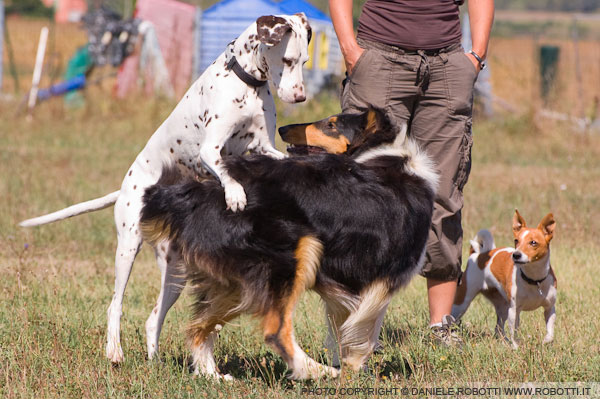
The Dalmation x Pointer cross intervenes in aid of the Jack Russell, who belongs to the same family group, by riding up with both forelegs on the Collie bitch, thus directing the collie's attention towards herself and away from the Jack Russell.
Imposing Behaviours: Categories
While for the first part of the ethogram regarding agonistic behaviours I was able to take advantage of available scientific references alongside my own research, for the category of imposing behaviours I found myself to a certain degree in uncharted territory. In other words, what you'll be reading on this CD-ROM derives from my personal experience, and from the interpretive framework I've developed, as well as validated scientific knowledge. During the development of this ethogram of imposing behaviours, four sub-groups emerged:
1. Postures / Stances
2. Space control
3. Resource control
4. Marking
1. POSTURES / STANCES
The first description of standing tall in an erect posture was made by a prestigious author: Charles Darwin. As Darwin wrote in “The Expression of the Emotions in Man and Animals”, “When a dog aaproaches a strange dog or man in a savage or hostile frame of mind he walks upright and very stiffly; his head is slightly raised, or not much lowered; the tail is held erect and quite rigid; hairs bristle, especially along the neck and back; the pricked ears are directed forwards, and the eyes have a fixed stare.”
In the erect posture referred to in this ethogram with the term 'standing tall', the head and tail are usually both held high, but at times the head is held high but the tail low, or vice versa: tail high and head low. Dogs with head high and tail low are displaying ambivalent behaviours indicating aggressiveness and fear (fight or flight).
For example, dogs may raise their head if alarmed in an attempt to try to collect better sensory information. In an interaction, raising the head may be associated with self-confidence, imposing, or confrontation. For example, a dog may try to hold his eyes at the same level as those of his opponent, or higher, and a small dog may rear up on his hind legs, if there is a fence separating him from another dog, and place his front paws on the fence and thus suceed in holding his head higher.
A dog's tail is in a certain sense much like the needle of a compass, in that it is an indicator of his emotional state: arched -confrontation / aggressiveness; vertical - imposing/confidence; horizontal - neutral/anticipation; low - social contact/insecurity; tucked between the hind legs - fear. This is admittedly a rather crude translation of the possible variations in tail shape and position, and yet, although observing the tail doesn't give us nearly enough information to evaluate a dog's behaviour, it is an important visual element in dog communication, and one which is easy to observe. Indeed, variations in the height at the base of the tail (more or less the first third), in how stiffly it is held (is it arched ? outstretched to full length ?) and in vertical and horizontal movements can be easily recognised. That is-- unless the dog's tail has been deformed either through selective breeding, or amputation (docking).
One behaviour that I've inserted in this ethogram even though it is still being studied is the shoulder display. Lateral stances are particularly complex to analyse, as they are composed of a range of different elements (position, distance, posture...). One of these elements is a forward motion of the foreleg nearest the antagonist which brings the shoulder clearly into view; this is a stance that is easier to observe in dogs with the typical lighter band of hair along the shoulder.
The bow
Many years ago, I read an article on the bow as a “metasignal” used during play. A metasignal is a behavioiur whose function is to change the meaning of behaviours displayed either previously or immediately after it. Seen as a metasignal, the function of the bow would then be of informing the other dog that all of the behaviours preceding the bow, or following it, weren't or won't be “serious”, but rather playful. For a long time I took for granted that the bow was nothing more than a play signal that served to invite another individual to play, or in any case to show playful intentions. I don't remember when I started to look at the bow in a different light, but I do know that today when I see a dog bow I think of something entirely different.
There are, perhaps, two types of bow. The first is the play bow. In it, the front legs are parallel, and in general it's followed by the dog moving away from its companion and swerving to the side or running away while maintaining eye contact (a sort of 'catch-me-if-you-can'). In the second type of bow, the front legs are held wide open, and the dog is in a frontal stance and may remain still, move closer, or move away and then move back into a frontal or rear position.
The most significant aspect of this bow is that it is closely linked to imposing behaviours, in particular to displacement. In other words, the bow is a precise signal meaning “move !”
I've also inserted the bow in the ethogram of agonistic behaviours, because I've observed it very often during face-offs between dogs, at the beginning of and during confrontations. In the case of imposing behaviours, the bow is not associated with threat displays or attacks, and is more of a show of phyical strength and self-perceived power in the interaction, without the aggressive component.
The next time you see a dog display a bow, instead of jumping to the conclusion that what you're seeing is a “play bow”, try to observe the interaction in greater detail, and very likely what you'll see is a dog who is trying to displace another dog.
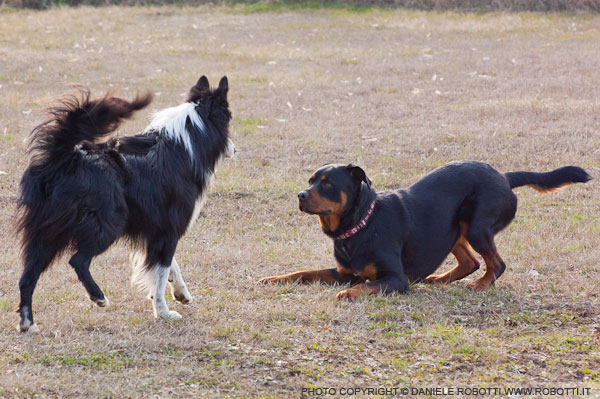
The Rottweiler displays a bow with her front legs wide open towards the male Border Collie. What the rest of the world sees as a play bow, to me is a display of self-perceived power...
The bow and a framework for interpreting it
The bow is an excellent behaviour with which to evaluate how our interpretative framework can change according to how we attribute meaning to a behaviour.
If we see the bow as always and in all situations just an invitation to play, then we'll interpret the dog we're observing as not trying to impose himself and not trying to displace his opponent, and the entire interaction can be explained in terms of “play”.
If the bow is instead an imposing behaviour, and the dog who displays it is attempting to displace his opponent, our interpretation of the interaction may instead be that it has nothing to do with play. As far as I know, I am the only researcher who to date has classified a bow among the imposing behaviours, and this difference undoubtedly influences my evaluation of the interactions I observe. Obviously, you're not obliged to adopt my framework for interpreting the bow, but having a different explanation available can make it possible to observe interactions from a different standpoint.
2. SPACE CONTROL
In lists of imposing behaviours we usually find descriptions of erect posture (standing tall), resource control, marking and T position. Other behaviours included are related to the use of space: passing first through tight spaces (e.g. doors or gates), lying down in or taking up a position in strategic places, or taking over privileged spaces. In all these cases, however, space is considered a resource to control and defend.
My attention has been attracted by body orientation, and by the control of movement in space.
In my observations of dog-dog interactions, I've begun to pay attention to what I call a “lateral display”: the dog orients in such a way as to display its flank. I've identified two different types of lateral display: lateral “control” displays and lateral “contact” displays. The first results of my research on this were presented at the “Learning About Dogs” conference in Birmingham in October 2006.
For the occasion, I surveyed and searched through the scientific literature to see whether or not others had already described these behaviours, and discovered that the only scientific reference to them was in an article by Shenkel (1967) on dominance in wolf populations. Schenkel published an illustration in which one of two wolves is depicted in a possible lateral “control” display. I later found another reference to these behaviours in the ethogram published by Barbara Schoening (2006), which includes T2 position. In T2 position the dog stops in front of another dog, displaying his flank and thus blocking him and keeping him from moving forward into his space.
My research on the use of space, in terms of distance, body orientation, control of movement, has continued over the years, and been enriched by new hypotheses. As dogs have a noteworthy spatial awareness and perception of the position of other individuals in space, it makes sense that movement and orientation take on particular importance in social interactions. As a result, among the imposing behaviours I've inserted all the behaviours involving control of space, the intensity of which varies from stopping another dog from moving forward by turning the head or with a glance to knocking it down and standing over it. A few of these behaviours (such as the bow with forelegs held wide open) have also been inserted in the ethogram of agonistic behaviours; in this case, there are differences in the degree of intensity and/or the outcome of the interaction.
3. RESOURCE CONTROL
In the Western world, dog owners tend to prevent, avoid or repress dog-dog and dog-person competition and conflict. For this reason, it's fairly unlikely that two family companion dogs will be given the opportunity to compete freely for the control of resources.
Even someone who lives in a multi-dog household (as I do) will tend to avoid conflicts by ensuring that multiple resources are available (two dog beds, two food bowls, two bones to chew on, etc. if the family has two dogs), and distributing resources both predictably and at regular intervals (e.g., food, water, social contact, play) through the use of both social and physical forms of control (e.g., fences, inhibition) or by choosing to put together dogs that are compatible (male/female, large/small, individuals with low levels of aggressiveness, etc.). A certain degree of competition and conflict, both toward conspecifics and toward people, is tolerated if it is not associated with clearly aggressive and/or harmful behaviour.
What's more, in encounters between unfamilar dogs, their owners tend to reduce the competition for resources, using similar strategies (for example, not playing with toys in the presence of other dogs).
Ad yet, despite the precautions used, dogs may display resource control behaviours.
In my experience the causes can be:
- competition
- a strategy adopted to define the relationship
- a reaction to a situation involving social stress
In the case of competition, control derives from the value attributed to a resource: a dog who normally doesn't show any resource control with food may change his behaviour if he is hungry, and males may control the access of other male rivals to an adult female.
In the second case, resource control becomes a statement of self-perceived power. The important aspect is not the resource itself, but winning the competition to gain possession of it. A typical example is competition in play involving toys, which can lead to an escalation in conflict, to the point of aggression.
The third hypothesis derives from my experience with dogs displaying aggressive behaviours when confronted with high levels of stress. A dog under a great deal of stress may appear to anchor himself to a resource, be it a space, an object, or an individual. In many cases aggression will occur near the dog's owner, and insecure or frightened dogs tend to seek refuge near their owners.
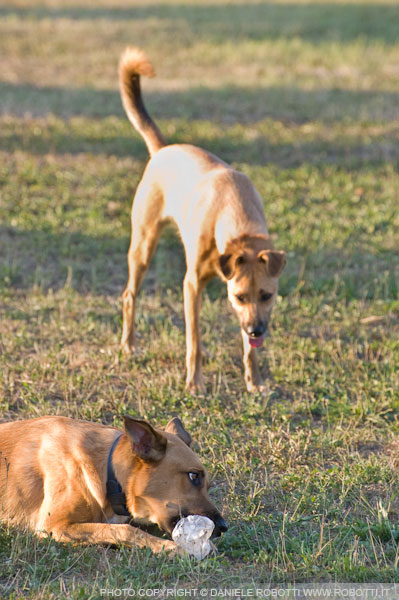
The mixed-breed male declares his ownership of the plastic bottle to the mixed-breed bitch.
4. OLFACTORY MARKING
Urine marking
Our sensory capabilities don't allow us to perceive and consequently understand the meaning of the odours that dogs use in their social communication. All that we can do is observe the behaviours associated with the perception of those odours, such as sniffing, teeth chattering, urination, eliminative paw scraping, or rubbing against something ...
Many of these behaviours are exhibited in association with imposing behaviours, and that's why they've been inserted in this category. The displaying of these behaviours, their frequency and intensity are all influenced by emotional states, including aggressiveness and stress.
When I embarked on a rehabilitation programme with a male Czech Wolf Dog, the first problem I had to face was his tendency to first mark with urine and then to display eliminative paw scrapes, both with extremely high frequency. The wolf dog would look at me, mark with urine, glance at me, display eliminative paw scrapes while growling, then orient towards me into a frontal stance, staring with a hard look, confronting me. If I tried to stop him from marking (either with my voice, or by moving closer), he was ready and willing to attack me.
In this case, marking preceded the confrontation/aggression, but often the sequence is the opposite: first the dogs confront each other, facing off, then they move away and transfer the confrontation to an olfactory plane. Two dogs may confront each other at a distance (over time or across a space) by means of olfactory marking: dogs who exhibit aggression towards conspecifics dedicate more time than other dogs do to olfactory exploration and marking, even if they are in a place where no other dogs are present.
Dog-dog confrontations also take place in the form of a sequence of marking behaviours: a stronger dog will mark over the urine of a weaker dog, sometimes displacing or stopping the weaker animal, keeping him from marking; this happens not only between males but also between females. If the dogs' roles are not well-defined, the sequence may be repeated several times.
Adult males tend to mark over the urine of adult females, and also in this case urine marking can be interpreted as a confrontation between potential rivals.
Shoulder rubs and anus marking
The earliest reference to the use of the shoulder in social communication that I know of can be found in the writings of Michael Fox, who described visual marking in canids. In wolves and some dogs there is a lighter-coloured band of hair at shoulder level. It was Sue Sternberg who, during a seminar on aggression in dogs, first pointed out to me the behaviour of shoulder rubbing as a form of olfactory marking. In this case, the dog rubs its shoulder against another individual, over an odour, or against an object. I have observed this behaviour above all in dogs showing a tendency to assert control, and in those undergoing high levels of stress. Shoulder rubbing can be displayed in association with marking with the perianal region.
Like the shoulder, the perianal area can be lighter in colour, and as a result the contrast in colour makes the displaying of the area even clearer when the dog raises the base of its tail. In some subjects, above all in males, the hairless part of the perianal area is particularly large. Sue Sternberg has described the behaviour of dogs marking other individuals, the ground or objects with the perianal area.
Some dogs tend to display these marking behaviours with a particularly high frequency, as I've seen in my experience both when observing Pit Bull and American Staffordshire Bull Terriers and also in other breeds and mixed-breed dogs (again, prevalently males).
Rolling over
Rolling on the ground is a behaviour which, in my experience, often corresponds to a peak in stress levels, or to a phase immediately following a peak in stress. The first time I evaluated this explanation was during an Obedience workshop, while observing participants' dogs. Time and time again, the dogs were busy working on an exercise when their handlers decided to interrupt the exercise to stop to talk to the worksop instructor. In the ensuing pauses, quite a few dogs displayed the rolling over behaviour. Since then (Novembre 2009), I've begun to observe the rolling over behaviour more carefully, verifying that it often follows stressful events. The frequency of this behaviour also tends to decrease after programmes aimed at reducing stress levels in the dog have been implemented.
Another reason for including rolling over in this category is that some dogs will intentionally roll over in a well-defined social space: in front of another individual, who may be literally pushed aside and thus displaced. The video dedicated to this specific behaviour illustrates this well, and shows a pit bull who had been seized by authorities during an illegal underground dog fight, and placed in the care of ENPA, the Italian national agency for animal welfare and protection. I filmed this dog during a behavioural evaluation performed as part of the ENPA “Ex-fighting dog” rehabilitation programme (the brave student shown in the test footage is Silvia Gotta).
PART ONE Introduction
PART TWO Imposing behaviours
PARTE THREE Ethogram of Imposing behaviours
start - contents - authors - bibliography - books & DVD |
