|
Leaving
Moving away, increasing the distance fom another
individual or other stimulus.
(Goodmann, 2002;
Koler-Matznick, 2005; Capra, 2011)
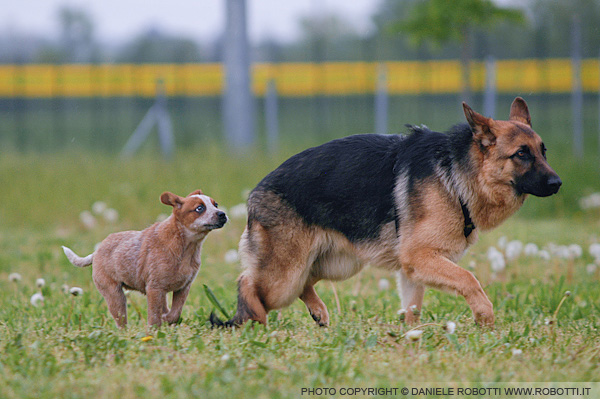
In this interaction between two females,
the Australian Cattledog puppy has approached a young
German Shepherd, who responds by moving away with
hindquarters lowered, ears back and a facial display of
fear.
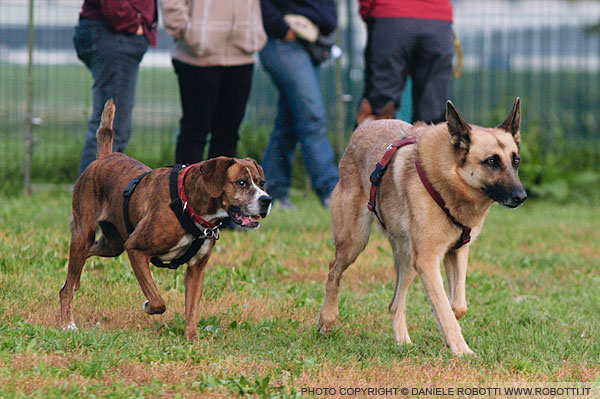
As the German Shepherd moves away to
leave the interaction, ears turned sideways, the female
Boxer follows her.
VIDEO
large
screen
The Golden Retriever bitch has approached the male at a
trot, stopping in a lateral stance about 4 meters from
the male. She turns and leaves; when the male approaches
she stops in a lateral stance and looks at him. The male
stops, turns his head, and walks toward her
hindquarters. When he sniffs her anal-genital area, she
turns to look at him. When she turns to face him, he
startles, lowers his tail, shifts his weight back and
hunches his back, hackles raised. They sniff each
other's muzzle, and when the Golden Retriever circles
around to sniff his anal-genital area, the mixed breed leaves,
first at a trot, then at a gallop, with hindquarters
stiff.
leaving
the interaction<>licking
the flews
|
