|
PART TWO- Fear
Definition:
Apprehension associated with the presence of or
proximity to a stimulus provoking it. (Overall, 2001).
Fear involves a reaction triggered by anything that
could be considered dangerous and becomes the motivation
that leads an animal to react to a threat.
Fear is part of the normal range of behaviour and, if
proportional to the context, is adaptive, in that it
alows the triggering of physiological and psychological
processes that have the function of increasing an
animal's chances of survival.
In puppies, fear is not exhibited before the age of 5
weeks. According to Scott & Fuller (1965), puppies
go through a phase of attraction-investigation through
age 4 weeks, after which, at 5 weeks, fear towards
unfamiliar stimuli appears. Fear is one of the main
factors triggering aggressiveness, together with stress
(Schoening, 2006) and frustration (Archer, 1974; Archer,
1976; Gallup, 1965; Schoening, 2006).
According to some authors, fears can be divided into two
categories: those tied to survival and those linked to
social interaction. The former are related to
self-preservation and essentially offer two
possibilities: fight or flight. Social fear is instead
provoked by other dogs and generally requires past
social experiences. In this case, besides fight or
flight, the animal also has a third strategy available:
compromise, which may involve, for example, submission
(Abrantes, 1997).
According to Rogerson (1997), levels of fear can be
evaluated in three ways:
1. by observing a dog's response in normal, relaxed play
with a high-value toy, then comparing this response to
that with the same toy in the presence of stimuli
triggering fear;
2. by observing a dog's desire to obtain high-value
food, then comparing it to behaviour in the presence of
stimuli inducing fear;
3. by observing the behaviour of the dog in a
non-stressful situation, then measuring how long the dog
takes to return to this condition of serenity after
exposure to and then the removal of any stimulus that
causes fear. This "recovery time" is a useful tool with
which in evaluating a dog's progress as it moves through
a rehabilitation program.
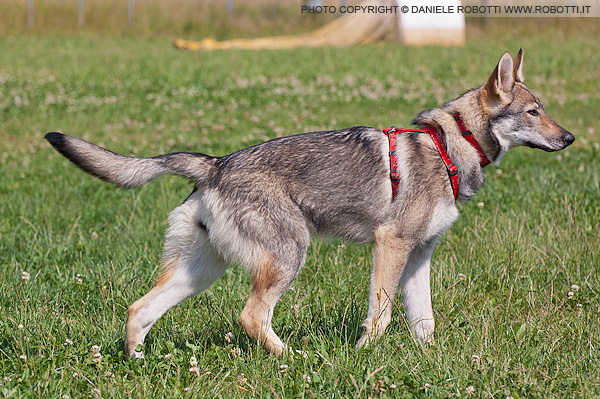
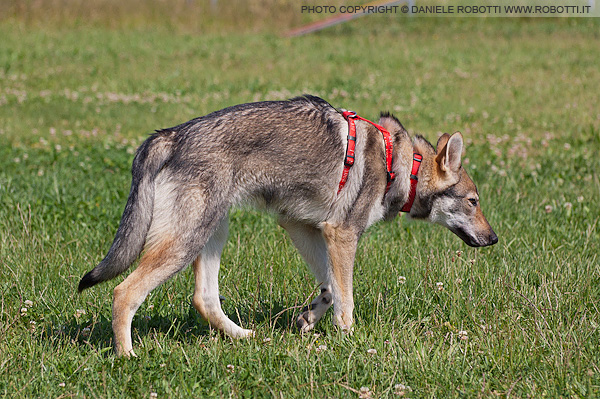
Emotions can be shown through
expressions, postures and behaviours, and observing a
dog makes it possible to identify variations in the
animal's emotional state. Upon seeing several unfamiliar
dogs, this young female Czech Wolf Dog initally
exhibited behaviours indicating attention and alert (see
top photo). In the second photo, in response to the
approach of one of the dogs, the young female has
lowered her head, turned her ears sideways and lowered
her tail. Although her harness is partially hiding it
from view, her hackles are raised on her neck and
shoulders.
Anxiety, panic and phobias
Anxiety is a state of
alert without an apparent cause. The dog is in a state
of constant emotional activation, or arousal, and
exhibits movements that are uncertain and restless.
Panic is a state in
which a dog's arousal provokes an internal emotional
response (the autonomic nervous system).
Phobia is the term
used to describe fear of specific stimuli that may
increase in intensity over time or be immediately of
maximum intensity (panic).
Avoidance and aggressiveness
It might not seem difficult to recognize fear in a dog:
he'll try to appear smaller, holding his tail between
his legs, eyes held wide open, pupils dilated, and he
may be trembling. These behaviours are always directed
towards whatever it is that the dog perceives to be a
danger: indeed, one of the distinctive features of fear
is attention directed towards something or someone, and
an attempt to flee, or to distance oneself from that
person or thing. However, fear can also be expressed
with less obvious behaviours, such as avoidance.
A dog who doesn't dare interact with something or
someone may in reality be scared. He may appear to be
uninterested, busy himself with other activities such as
sniffing the ground or interacting with something or
someone else, perhaps from a distance. The dog's
emotional state will become more apparent if he is
forced to come into contact with whatever is worrying
him. An insecure or fearful, worried puppy will try to
avoid an encounter, and if forced will struggle to get
away or passively endure the situation. Often this sort
of continuing exposure to fear-related contact with
others may result over time in the dog showing an
intense reaction upon reaching sexual maturity. This is
the reason behind the commonly held idea that puppies
become more aggressive upon reaching the age of 7-8
months, while in reality these reactions have their
roots in negative experiences during the first months of
life (the so-called "socialization" window).
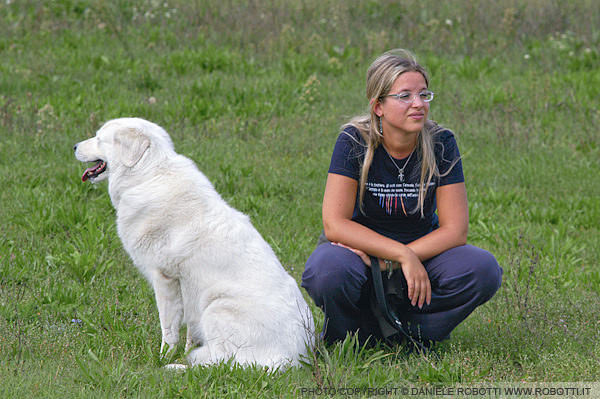
This female Maremmano Abruzzese is a
former shelter dog who was adopted when she was five
years old. She is in a fenced enclosure where there are
unfamiliar people. She has sought support form her
owner, turning her back on the strangers and avoiding
looking at them.
Tail up, standing tall
In this ethogram I have included imposing behaviours
that are normally associated with self-confidence: a
raised tail held high and standing tall. Why ? Once,
when a couple traveled by camper to meet with me for a
behavioural evaluation of their Golden Retriever, my
attention was immediately captured by his tail, which he
was holding high. The dog had been attacked three times
by other dogs. When I commented, "he doesn't have
problems with other dogs, does he ?", the couples'
response was, "well yes, but since those episodes he has
continued to carry his tail raised, something he never
used to do." Indeed, a dog whose tail is raised often
has his head lowered, as if his body were divided in two
parts: the head up giving clear messages regarding
avoidance and insecurity, while the tail up signals
imposition and confrontation.
When standing tall, a dog is holding both head and tail
raised high. And while this posture is generally
associated with self confidence as an imposing
behaviour, if associated with a stiff gait (e.g., the
dog may appear to be walking on the tips of its toes,
moving slowly), in reality it is a behaviour indicating
fear. The dog is preparing to defend itself in the face
of danger, and is trying to appear big enough and strong
enough to stop his opponent.
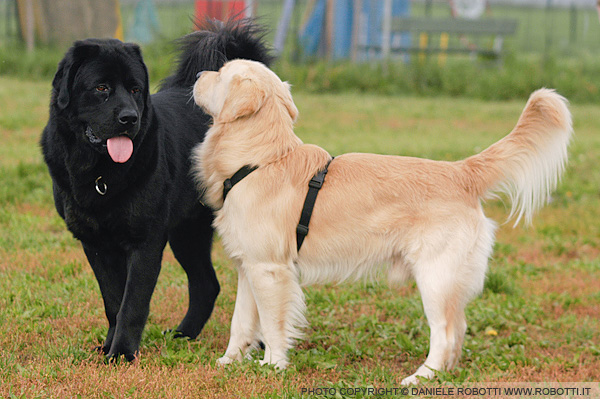
In this encounter between two males, the
Golden Retriever is standing tall, facing off with a
Tibetan Mastiff. The Mastiff has moved into a lateral
stance, staring at the Retriever, who has pulled his
head back and is averting his gaze.
Fear and aggressiveness
In the scientific literature we can find reports of
what is defined as fear-induced aggressiveness, and
indeed a defensive attack may be triggered by fear,
especially in situations in which the dog doesn't have
the possibility to leave the interaction or flee
(Lindsay, 2001). In describing a dog in a state of
fear-related aggressiveness, Beaver (1994) noted that
the dog's postures can indicate either the intention to
increase the distance between it and the stimulus
triggering its fear, or a warning before an attack, or
instead be ambivalent, indicating conflicting reactions
of fear, submission and aggression. According to Beaver,
the dog may then stare at whatever it is he sees as a
threat as he lowers his head and crouches down. Other
signals include piloerection (hackles raised), tail
between the legs, ears lowered, muzzle wrinkled,
horizontal then vertical retraction of the flews and
growling. If the threat persists, the dog may exhibit
snapping, attempt to bite, urinate, defecate and empty
its anal glands.
If the dog doesn't show simultaneous signs indicating a
mixture of both aggressiveness and fear, the
aggressiveness is generally considered to be offensive,
rather than defensive. Nevertheless, over the years,
I've learned to associate this category with fear.
Although my impression is only a hypothesis based on my
experiences in working with dogs, we do know that fear
is associated with two opposite strategies: fight, and
flight. Dogs that tend to react with agonistic
behaviours may not exhibit clear signs of fear. They may
appear self-assured, and display imposing behaviours,
decreasing distances or escalation, and yet, even if a
dog appears self-confident, aggressiveness is an
indicator that there is something going on that the dog
is having serious difficulty coping with.
For a dog, aggressiveness is likely to have costs that
are much higher than its possible benefits, both in
terms of risks and emotional arousal, in that
aggressiveness represents a loss of control (both
internal and external) and this undoubtedly is a cause
of stress and fear.
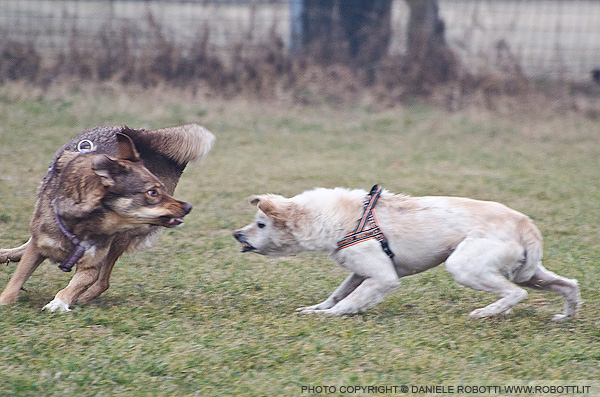
The male cream-coloured mixed breed
initially threatened and attacked the sable mixed breed
female, who has responded by swerving to the side and
then reacting with an agonistic pucker. The male is now
using signals that indicate both threats and fear: an
agonistic pucker, low posture and tail between his legs.
PART ONE
Introduction
PART TWO Fear
PART THREE
Stress
PARTE FOUR
De-escalation behaviours
ETHOGRAM
start
- contents - authors
- bibliography - books
& DVD
|
