|
PART THREE - Stress
Definition: Any
situation in life which places demands on the adaptive
mechansisms of the body creates stress, the "the
non-specific response of the body to any demand for
change" (Selye, 1976). Every stressor, regardless of
whether it is consciously perceived or not, produces
emotional, neurological, locomotor, hormonal and
immunological regulatory mechanisms; in higher organisms
cognitive functions also come into play.
A little background information
The scientific term 'stress' was first used in the
field of physics. Physicist and biologist Robert Hooke
(1635-1703) used the term “stress” (exertion) to
indicate the area in a structure in which a load is
borne, and “strain” as the deformation caused by the
interaction between stress and load.
Claude Bernard (1957), the acknowledged father of modern
physiology, was the first to introduce the concepts of
an “external environment” in which an organism is
situated and its internal environment, that is, the
environment in which organs and tissues live. According
to Bernard, the constancy of this ’inner environment is
an essential condition for life, a concept first defined
by Walter B. Cannon (1915) as “homeostasis”. Cannon also
described the “fight or flight” responses to acute
stress”.
The first detailed studies on the biological mechanisms
of stress were performed by Hans Selye (1976). Selye
wrote that “the non-specific response of the body to any
demand for change “ creates stress”. This fact regards
both positive and negative experiences: any stimulus, be
it endogenous or exogenous, physical or psychological,
is a stressor, and the body's response to it is stress.
Selye used the term “general adaptation syndrome ” to
describe the sum of all the reactions of an organism
following a prolonged exposure to a stressor, (Selye,
1936) and made the distinction between eustress and
distress, that is, physiological stress and pathological
stress. The former activates an easily reversible
response that is not quantitatively excessive, while the
latter induces an irreversible response that is
disproportionate to and prolonged beyond the actual
resources of the body. Eustress is a function of an
increased ability of an individual to adapt to changes
in the environment.
According to Ewbank (1985), there are three forms of
stress:
-Physiological stress, which is the level of stress that
is entirely adaptive and is associated with the ability
of an animal to return to or maintain a state of
well-being.
-Overstress, which individuals are likely to adapt to
but which can cause damage to the health of an animal;
-Distress. While it is possible to adapt to it, distress
is nevertheless associated with harm to an animal's
wellbeing, and is manifested through behaviour with
negative effects not only on the animal's comfort but
also on its reproductive health.
While it is possible to adapt to distress, it is
nevertheless associated with harm to an animal's
wellbeing, and is manifested through behaviour with
negative effects not only on the animal's comfort but
also on its reproductive health.
Morberg (1987) hypothesized that despite its relatively
brief effects on the autonomic nervous system, the
hormones released by the pituitary / hypothalamus system
have a long-term effect on the body, and that the immune
system also plays an important role in the response to
stressors.
Acute Stress
Definition: Any event
produced over a certain (generally brief) period of
time, and which, if it does recur, does so only
infrequently. (Burchfield, 1979).
Gray (1987) divided fear-provoking stimuli into five
groups:
- unfamiliar stimuli
- intense stimuli
- stimuli associated with genetic predispositions
- stimuli that emerge during social interactions
- conditioned stimuli dependent upon the context in
which they occur.
Many authors have described the following behaviours as
symptoms of acute stress:
Standing or sitting with lowered / crouching posture,
trembling, vocalizations, attempts to flee; if the
attempt to flee is blocked, frenzy, aggressiveness
toward the perceived source of pain / fear, whimpering,
nose-licking, oral behaviours, open mouth, raised front
paw, shaking off, uneasiness (shown through movement or
barking), yawning, urinating or defecating, hunched
back, tail between the legs, piloerection / hackles
raised, stiffness, thigmotactic reactions (those toward
or away from any object that provides a mechanical
stimulus) which may include attempts to lean against or
lie on the owner or objects (including the floor),
lowering the head, avoiding eye contact, ears flattened,
squealing or yelping (Friend 1991, Schwizgebel 1982,
Beerda 1997, Lindsay 2001).
Rebound behaviours
Definition: an
intensified display of a particular behaviour, after an
individual has been prevented from performing it for a
period of time. (Friend, 1991)
In a study on dogs, it was observed that frequency of
barking increased after the dogs were forced to wear an
anti-barking muzzle. (Cronin et al., 2003).
The first time I heard the term "rebound behaviour"
mentioned was in a different context. I was trying to
see the effect of a plastic dog on my Border Collie, who
at the time was three months old. Grisou would threaten
a plastic toy dog when it was in a frontal position,
would approach and sniff it when it was in a lateral
stance, and was ready to flee at the first reaction of
what he clearly viewed as a bizzarre creature ! When I
picked up this model Boxer and Grisou realized that it
was just a piece of plastic, he became extremely excited
and began to jump up and down, trying to grab it. At the
time, an ethologist friend described this display as
rebound behaviour, and I think I replied, “ah.... sure
!”, then went to find out just exactly what this effect
was! While I'm not sure that it exactly fits the
description, for me, rebound behaviours are what we see
when a dog, after having gone through a moment of
extreme stress, no longer has to face the cause of its
fear or worry, but still has high levels of adrenaline.
Chronic stress
Definition: “a stimulus
to which an organism is continually exposed ”
(Burchfield, 1979).
One of the main causes of chronic stress in animals is
the impossibility to satisfy basic behavioural needs
(Friend, 1991), such as the need for social interactions
(Dellmeier et al., 1985; Panksepp e Beatty, 1980),
movement (Dellmeier et al., 1985), play (Brownlee, 1954)
and rest (Dellmeier, 1989).
An important aspect of stress-related behaviours
underlined by Friend (1991) is the fact that:
“Behaviours described as abnormal can often be
considered as normal responses to abnormal
environments”.
Behaviours such as pacing back and forth or in a circle
in a small fenced-in area are an example of how the
absence of sufficient space and above all of stimulation
can be potentially damaging conditions for dogs.
Consequently, in the presence of abnormal behaviours,
the correct strategy to safeguard the wellbeing of a dog
is not to modify its behaviour but rather to lok at and
change the physical and social environment in which it
lives.
According to Friend (1991), generally speaking, the
responses shared by different species of animals in the
face of these kinds of deprivation include:
- learned helplessness;
- rebound behaviours;
- stereotyped behaviours;
- lack of behaviours that would normally be expected in
a given species.
In the fourth category we find behaviours such as
self-cleaning of fur, play, exploratory behaviours,
shorter resting time, less time spent in sleeping, less
eating and drinking. Some of these behaviours can be
included in the range of symptoms typical of depression
(Pageat, 2000).
In a 1998 study, Beerda et al. exposed a group of 15
Beagles to a situation of confinement and isolation for
a period of 6 weeks, as a model of chronic stress in the
dog. The behaviour of the dogs was then compared to
their behaviour over an equivalent period of time in an
enriched environment, living in a group in a large area.
During the period of isolation, the dogs showed an
increased frequency of self-grooming (as a stereotyped
behaviour), raising of a front paw and vocalizations,
all of which are stress-related behaviours. An
association was also found between episodes of
coprophagy and these repeated behaviours. These
behavioural changes were interpreted as an indicator of
chronic stress, and were accompanied by an increase in
aggressiveness, arousal and uncertainty. Indeed, a
period of chronic stress, even if it is not particularly
intense, will induce more extreme behavioural responses
when other chronically stressful factors are present: an
animal that previously had not suffered the effects of
chronic stress will have greater reserves of energy
available to rely on if faced with a situation of
chronic exposure to a stressor compared to a dog which
has already been subjected to the same situation.
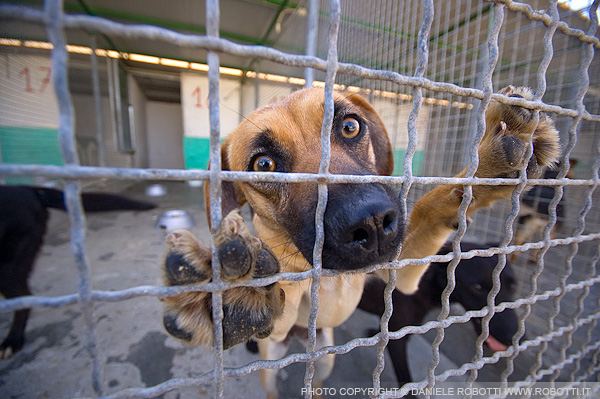
While many dog shelters try to guarantee
acceptable care and living conditions for the dogs in
their care, the situation itself puts the dogs'
wellbeing at risk.
Learned helplessness
Definition: Learned
helplessness develops when an animal is subjected to
chronic and unavoidable stress (Overmaier &
Seligman, 1967).
Overmaier & Seligman (1967) demonstrated that,
after dogs were exposed to chronic unavoidable electric
shocks, they developed the inability to escape the
shocks even when escape was possible. Repeated
unsuccessful attempts to escape negative events produce
an inhibition of the behaviour and provoke a state of
depression.
Learned helplessness leads to three types of deficits
(Seligman, 1975):
- Cognitive deficits: a perceived lack of control
- Emotional deficits: fear of certain situations and
anxiety when dealing with them, along with depression,
apathy and resignation in the face of (unavoidable)
failures.
- Motivational deficits: loss of self-confidence.
One of the cases of learned helplessness I remember most
clearly was that of Zeb, one of the pit bulls in the
ENPA ex-fighting dogs rehabilitation project. When in
his kennel run at the shelter he seemed to be an active
and normally reactive dog, but as soon as he was
leashed, he would lean against the person holding the
leash, and remain passive. While in the area used for
rehabilitation activities, he would refuse to eat,
regardless of the type of food offered. Since he would
eat voraciously if in his kennel run, my strategy was to
use his bowl to give him food in the area we worked in.
This strategy had worked well with a German Shepherd who
had been traumatized by coercive training methods and as
a result would flee as fast as possible and begin to try
to catch real or imaginary flies at the sight of a hand
taking a piece of food out of a bait (treat) bag. At the
end of the rehabilitation program, Zeb was adopted and
today is a happy member of a new family.
VIDEO
large
screen
This is Zeb, one of the pit bulls in the ex-fighting dog
rehabilitation program, filmed during a behavioural
evaluation. When the trainer bends over, Zeb approaches
and closes his eyes, with a lowered posture, and lowers
his hindquarters without relaxing his muscles, averting
his gaze and avoiding eye contact.
Stereotyped behaviours
Definition: Behaviours
usually provoked by a conflict, and which are them
exhibited outside of the context in which they were
originally exhibited; these behaviours appear abnormal
because they are acute; they are displayed out of
context and are often repetitive, excessive and
prolonged over time (Hewson & Luescher, 1996).
Lindsay (2001) underlined the fact that stereotyped
behaviours are generally ordinary behaviours expressed
out of their normal context, or in an exaggerated
manner, and that they occur under natural conditions
involving conflict or frustration. Stereotyped
behaviours are species-specific and occur in similar
forms in animals of the same species. These behaviours
include physical activity (moving in a circle,
tail-chasing, pacing back and forth), oral behaviours
(biting or licking itself, scratching biting or licking
objects, polyphagia, polydipsia, pica), aggressiveness
(self-directed, towards people or towards inanimate
objects), vocalizations and behaviours ascribed to
hallucinations (Luescher, 2002).
Stress and aggressiveness
This paragraph is not based on information from the
scientific literature, but rather on observations from
my working life. When I evaluate a dog who is showing
aggressive behaviour, stress is a big part of the
picture. In communication skills classes, each dog is
free to interact with the other dogs, with its owner and
with the other people present. Stress can cause an
aggressive reaction upon seeing another dog. This
reaction can occur regardless of the sex, size or age of
the other dog, or the behaviour it is exhibiting. In the
most extreme cases, dogs attack, hurtling at full speed
against the unfamiliar dog. This can't be considered a
social behaviour, as there is no type of communication
or interaction, only a pure reaction linked to fear,
frustration and stress. The causes of this behaviour can
be a lack of interaction with other dogs for months or
years, or inhibition or punishment from the dog's owner.
Physical pain or discomfort, as well as insecurity due
to physical weakness, can increase stress levels and
provoke aggressive responses.
I will never forget Full, a 4 year old male German
Shepherd. Upon arriving at my training center, his
owner, a woman in her 70s, stepped out of her tiny green
car and immediately opened the back hatch and invited
her dog to hop out. As soon as I saw the dog, I stopped
in my tracks at a safe distance and asked her to not
move towards me. When I called out "Is your dog
aggressive ?" she replied "Yes, he most certainly is!"
When I asked "Towards ?" she replied "Everyone !!!! He
bites everyone !" On the training field, the dog was
extremely reactive, trying to attack me every time I was
anywhere near his hindquarters. I asked her if she had
had the dog checked out by a veterinarian, and if he had
shown problems with his hind legs or back. Later, when
the dog underwent a check-up by a veterinarian, serious
problems were found with one of his knees, which was
then operated on. After the operation, the dog's level
of aggression decreased to the point where it was
possible for him to be handled by his two elderly
owners.
When faced with problems related to aggressiveness,
before considering any type of intervention or
rehabilitation program, a fundamental first step is
reducing the level of stress the dog is dealing with,
and evaluating just how much this influences the dog in
different contexts. Reducing stress makes it possible to
evaluate in greater detail the effects of other
elements, such as personality, experience and physical
and social environment.
Coping strategies
Definition: The term
coping derives from the verb to cope, meaning to deal
with and attempt to overcome problems and difficulties.
Coping is a behavioural reaction to an adverse
situation: that is, a situation inducing a reaction of
physiological stress (Wechsler, 1995).
In contrast with what was hypothesized by Selye,
different individuals exposed to the same stimulus may
react in very different ways, both in terms of their
physiological response and how they experience the event
from a psychological standpoint. Indeed, cognitive
scientist Singer has defined a stressor as a mental
construction regardless of its physical characteristics.
In this process of cognitive evaluation, a stimulus
takes on different meanings for different individuals,
and as a consequence stress responses of different
duration and degree will be activated, or not activated,
in association with different and entirely personal
combinations of emotions experienced. A stress response
is therefore an active and subjective process.
With respect to the concepts of eustress or distress
described by Selye, today there is a tendency to shift
attention away from the characteristics of the event
triggering stress and instead to attention on the way in
which each single individual copes with the event.
Different authors have underlined the fact that animals
use both active (proactive) and passive (reactive)
coping strategies: an animal exhibiting an active
strategy is trying to remove the source of stress or to
escape it, whereas animals using passive coping
strategies tend to reduce their activity level and
accept the conditions of their environment rather than
try to modify them (Benus, 1991).
Psychologically, a given style of coping will be
effective if the individual is able to return to the
state of emotional equilibrium which had been altered by
exposure to the stressor. From a physiological
standpoint, the efficacy of a given coping strategy lies
in its ability to decrease the frequency and intensity
of the neuroendocrine response induced by the stressor.
Natural coping strategies
I first began to think in terms of coping strategies
when my attention shifted from what the dog is doing to
why the dog is exhibiting certain behaviours: in other
words, from the behaviour to the emotional state. In
living with my dogs, I was aware of and used these
strategies, but I didn't have a theoretical framework
that would allow me to use them effectively in training
and rehabilitation. My Belgian Malinois, Matisse (who
was born in 1996), would encounter other dogs holding a
toy in her mouth. I had discovered that this simple
solution made it easy for her to control her
aggressiveness and relieved the stress that interacting
with other dogs caused her. When holding her toy, she
felt better. At the same time, a female Border Collie I
was working with was able to overcome her fear of
unfamiliar places by playing with a plastic bottle (when
no toy was on hand), and my Staffordshire, Bullet, was
able to calm himself if he was able to keep near me.
Coping strategies are described in the scientific
literature as behaviours adopted by an individual
undergoing some type of stress. In practical terms, I
think of coping strategies as anything that helps a dog
to feel better when faced with a stressful situation. In
my experience different dogs adopt different strategies:
- olfactory exploration and marking behaviours
- predation (pointing, chasing live prey animals or
objects)
- playing with objects/toys (grabbing, holding, chewing,
shaking, tugging and/or sharing them)
- motor activities /physical exercise (running, swimming
or running in water, jumping)
- social contact (seeking support, asking for physical
contact, play)
- resource control / guarding (the resource may be an
object, toy, food, person/owner, car or even other dogs)
In recent years I have used tugging to help my Border
Collie, Grisou, cope with the presence of other dogs.
Grisou has shown aggressive reactions to virtually any
and every other dog over the age of 2 and a half months
that he has ever encountered. PTo help him cope and feel
better, I've used a tug rope tied to a string, which
Grisou can grab and shake whenever he feels the need to.
Arjuna, my German Shepherd bitch, instead uses resource
guarding and social contact as her natural coping
strategies. Today she is a year old, and if she feels
stressed when left alone, she collects objects that I
have touched or worn and carries them (along with her
toys), to a couch, where she sleeps on her hoard much
like a mythological dragon in its lair.
Learned coping behaviours
Learned behaviours have always been considered tools
with which to control our dogs. Asking a dog to sit, lie
down or stay in a sit next to its owner equates to
inhibiting the dog's natural reaction to a stimulus. The
dog behaves “well” (the way its owner wants it to),
because it isn't allowed to behave “badly” (in an
undesirable way). Seen in this light, the effectiveness
of the strategy lies in what I call the aesthetics of
the behaviour, and yet the emotional state of the dog
and its wellbeing in general are ignored. The dog may
respond to its owner's request due to the fact that it
has been conditioned to do so or forced to comply, and
yet not being able to react to the stimulus can push the
dog into a state of avoidance. When the level of stress
becomes greater than that of inhibition, the dog's
reaction may be very intense and uncontrollable.
In a totally different framework, learned behaviours may
however become effective coping strategies.
Also in this case, it was my dogs who helped me to see
and understand this. Bran, my smooth-coated Border
Collie, has never been very sure of himself around
people-- especially men. One day, finding himself in an
extremely tight spot, he dealt with the stress by
sitting down next to a man's left leg. This exercise is
one of those used in Obedience competitions, and which
Bran knew well, as we had trained long and hard in
Obedience. As a result, this chain of behaviours had a
long history of reinforcement in Bran's mind, and had
become so gratifying that he was able to use it as a
learned coping behaviour. In the same way, during a
learning/training session, a dog may exhibit a certain
behaviour learned during the most stressful steps. Often
these are behaviours taught through play, using positive
reinforcement or shaping, and will often reflect a dog's
personal preference or a predisposition (for example,
spinning around).
In order for a behaviour to help a dog feel better in a
stressful situation, and thus be available for use as a
coping strategy, it needs to be the dog itself that
chooses it. Coping strategies can't be placed on cue,
requested or demanded. This is a key difference with
respect to conditioned behaviours used to maintain
control of a dog in the presence of a stimulus.
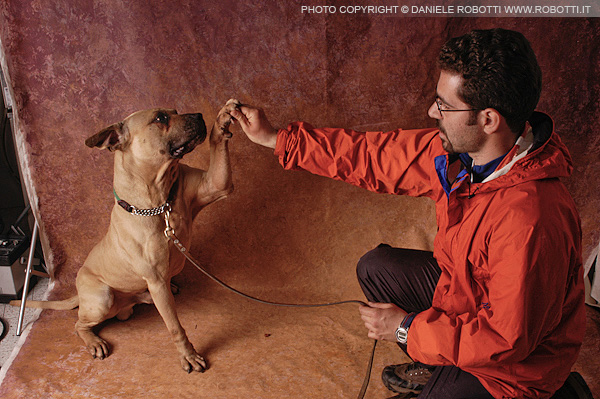
During the ex-fighting dogs project, I
chose to teach several pit bulls behaviours which, on
first glance, would undoubtedly seem pointless to many
people, and useless in the day-to-day management of the
dogs. One example was shaking hands. This one simple
behaviour is enough to change many people's perception
of a dog dramatically, since for the people who
encounter it, a dog that shakes hands is seen as a
friendly one). As a result, teaching a dog this
behaviour can foster positive reactions and social
contact, and give dogs a tool to use in relating to
people.
Fear and stress in training
I have purposefully included several video clips
regarding training sessions for sporting dogs.
For decades, the learning which took place both in basic
family dog training and in advanced training for
sporting dogs had the sole purpose of changing a dog's
behaviour to something desirable for its human
companion. In recent years, things have fortunately
taken a turn for the better, and a new way of thinking
and conceiving training is becoming ever more
widespread. Today, trainers see that there is also great
value in learning in that it is a way to give dogs tools
with which to make sense of, and relate to, their
physical and social environments, tools which allow them
to develop communication skills and emotional
self-control, to make the most of their cognitive
abilities and yes, even to have fun. In this sense,
learning has become something useful for the dogs
themselves, not just for their owners or handlers.
Nevertheless, learning can also be a significant source
of stress, and even of fear.
As Karen Overall wrote in 2007, violent punishments such
as those inflicted using electric shock collars “ work
to teach avoidance and cessation of behaviour (...)
which in the extreme form is called 'immobility'. It is
this criterion of 'immobility' by which learned
helplessness is accessed. Given this definition, I have
been surprised at how often those who support shock
ignore the fact that cessation may not be a hallmark of
'improved behaviour', especially when the welfare of the
animal is considered." Using these methods, clients
would find that their dogs (which had been subjected to
electric shocks in order to stop undesired behaviour)
had indeed become obedient. Obedient dogs can, however,
also be suffering from a high degree of stress, and
suffer states of profound anxiety when they are
requested to do something by their owners, because
coercive methods leave their mark on dogs, as can be
seen in the behaviours they exhibit related to stress,
fear and avoidance.
Some trainers have learned to cover up these signals
from their dogs by taking advantage of the stress
responses of some individuals (the dog may appear more
reactive), or by associating a behaviour with the ending
of pain (the dog will appear motivated in executing a
command). It is also worth noting that not all stress
exhibited by a dog during learning can be attributed to
the use of coercive methods or to a lack of respect for
an animal's wellbeing during the learning process: a
sensitive dog, or an insecure one, may show signs of
uneasiness simply in response to the sight of a tense
handler / trainer, or in response to environmental
stimuli (noises, dogs, people, etc.)
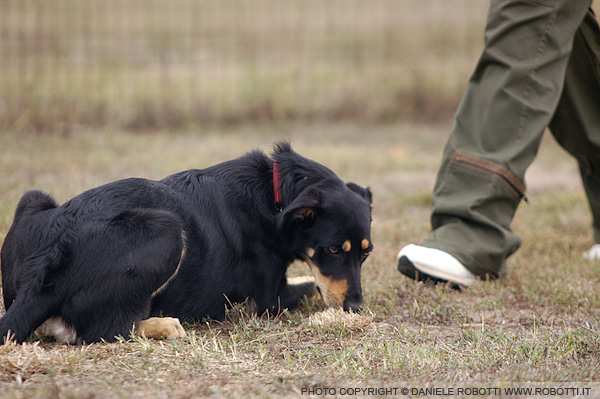
This German Shepherd mix has been cued
into a down-stay by her handler. When her handler
returns to her, the dog sniffs the ground.
PART ONE
Introduction
PART TWO Fear
PART THREE
Stress
PART FOUR
De-escalation behaviours
ETHOGRAM
start
- contents - authors
- bibliography - books
& DVD
|
