|
PART FOUR - De-escalation behaviours
Escalation refers to an increase in the intensity of
imposing or agonistic behaviours during an interaction.
A dog may stare, orient into a frontal stance, raise his
head, raise his tail, move nearer, displace another dog,
growl, or display an agonistic pucker... increasing the
intensity of its behaviour to the point of launching an
attack.
De-escalation behaviours instead go in the opposite
direction, and involve a decrease in the intensity of
imposing and/or agonistic behaviours. In 1971, Michael
W. Fox first used the term 'cut-off' signals: signals
which diffuse or block an opponent's aggressive
behaviour. Other authors have preferred the term
'pacifying signals'. Dogs do not follow fixed
behavioural patterns in their interactions, and do not
tend to follow rigid, recurring patterns when increasing
or decreasing the intensity of their behaviours. In my
analysis of over 200 aggressive interactions between
dogs, I did not observe a progressive and predictable
increase in the intensity of the signals / threat
displays preceding attacks. What's more, the outcome of
the interactions was also not predictable on the basis
of the de-escalation signals used by the victim. In
other words, a dog may be attacked by another dog even
if he is exhibiting pacifying behaviours. Indeed,
attacks often begin in the moment when one of the two
dogs tries to move away / leave the interaction. If a
dog's intention is to attack, the best moment to do so
is when his opponent shows signs of weakness.
Much like submissive behaviours, pacifying behaviours
can only 'work' if the other dog in the interaction
shows tolerance and also chooses to use de-escalation
strategies. For some years now I have been evaluating
and monitoring the rehabilitation of dogs who have
exhibited aggressiveness towards other dogs and people.
I distinctly remember the first time I tried to use
pacifying signals to handle an interaction with an
aggressive dog: the dog was staring intently at me, and
as I slowly turned my head away from him, avoiding eye
contact, the dog launched an attack, growling, his owner
struggling to keep hold of the leash and stop him. That
same day I stopped a German Shepherd who was charging at
me by turning into a lateral stance and avoiding eye
contact. In the latter case, the dog no longer felt
threatened by me and chose a different strategy rather
than attacking. In my experience, the best strategy
isn't trying to use de-escalation signals, but rather
having a good understanding of canine social
communication and reading the signals a dog is giving
correctly.
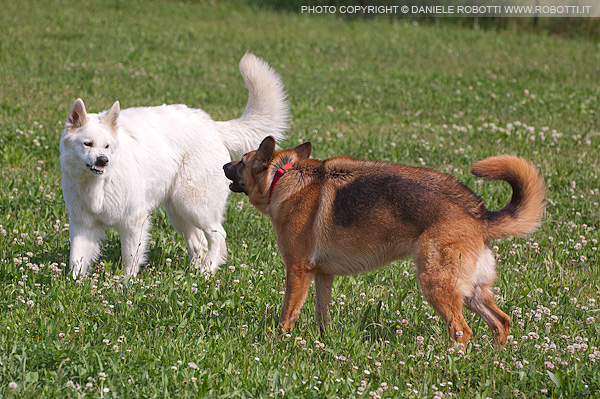
In this interaction between two females,
the German Shepherd has adopted a frontal stance and is
barking, hackles raised, as she approaches the White
Swiss Shepherd, who has reacted with an agonistic
pucker. This escalation behaviour by the White Swiss
Shepherd has blocked the German Shepherd.
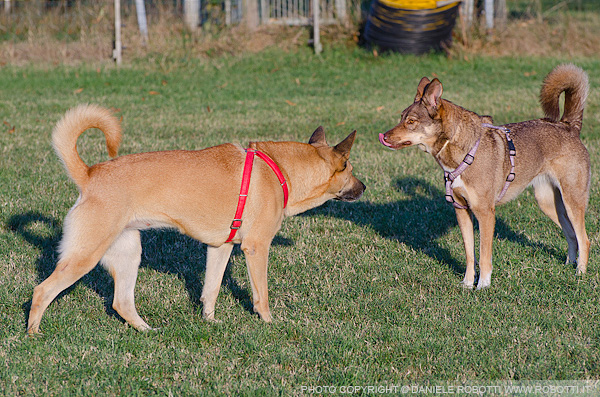
As the sable mixed breed approaches, the
mixed breed on the right has maintained a frontal
stance, standing tall, but is displaying stress-related
behaviours including licking her nose, ears turned
sideways, piloerection (hackles raised) and
de-escalation, averting her gaze to avoid eye contact.
PART ONE
Introduction
PART TWO Fear
PART THREE
Stress
PART FOUR
De-escalation behaviours
ETHOGRAM
A-
B - C-
D - E
- F - H
- I - J
- L - M
- O - P
- R - S
- T - U
- W - Y
start
- contents - authors
- bibliography - books
& DVD
|
