Raised tail
The base and the first third of the tail are held stiffly and raised vertically above the back. The tip of the tail may be moving rapidly.
(Feddersen-Petersen, 1978; Goodman et al. 2002; Koler-Matznick, 2005)
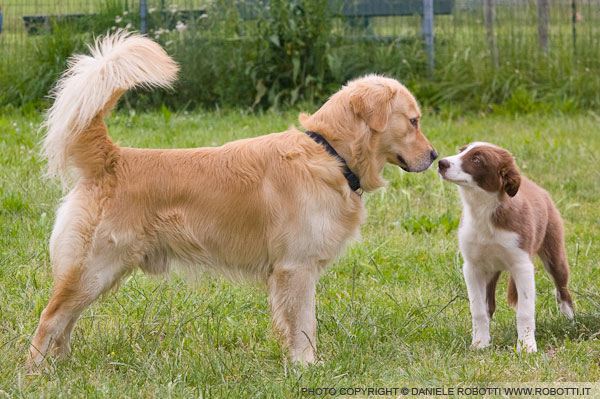
This male Golden Retriever is exhibiting standing tall with a raised tail in an encounter with a 3 month-old male Border Collie. The puppy has lowered his tail and flattened his ears back, and is holding his head high and staring directly.
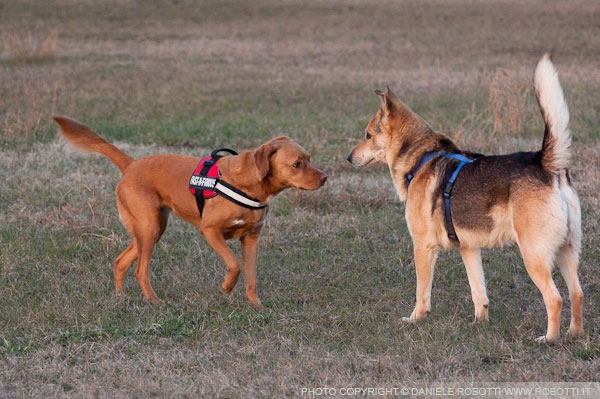
In this approach towards a female Pit Bull cross, the male German Shepherd cross exhibits standing tall and a shoulder display, with tail raised straight up.
VIDEO
large screen
The male German Shepherd cross raises his tail and walks tall towards the two females, then stops and startles. When the two bitches approach, he stiffens and stands tall, displaying hackles raised and a piloerector response along his entire spinal column and a raised tail. The younger of the two bitches, a female hound cross, has tail lowered and pilo-erection on her croup; the other bitch is wagging her raised tail. The male displays a tail-up wag toward the grey bitch, and attempts to move closer to the tawny bitch, who moves away with a rounded back and tail between her legs. In the last frames, the grey bitch exhibits T1 position and chin over.
pressing_down < > resource_control |
